

Fly Mask With UV Protection: A 2026 Guide for Horse Owners
Table of Contents
- Why Your Horse Needs a Fly Mask With UV Protection
- Equine Uveitis Eye Protection: How UV Masks Help
- How to Measure a Horse for a Fly Mask
- Signs of Eye Irritation in Horses: When to Act
- Choosing the Right Fly Mask With UV Protection
- Comparing UV Fly Mask Features and Value
- Care, Cleaning, and Long-Term Use
- Frequently Asked Questions
Last Updated: September 13, 2026
Why Your Horse Needs a Fly Mask With UV Protection
A fly mask with UV protection is a piece of equine gear that shields a horse's eyes and face from both biting insects and harmful ultraviolet radiation. For horses with light-colored faces, blue eyes, or a history of uveitis, this combination is not a convenience. It is preventative care.
Horses evolved as prey animals with large, exposed eyes positioned for nearly panoramic vision. That anatomy serves them well in open country. It also leaves them unusually vulnerable to sun exposure and insect-borne irritation. TUFFTEQ designs protection around that reality rather than treating it as an afterthought.
The stakes are higher than most owners realize. UV exposure accumulates over a horse's lifetime, and the damage it causes to ocular tissue does not reverse. Meanwhile, flies, gnats, and mosquitoes deliver constant mechanical irritation that can progress to infection. A mask addresses both threats at once.
Below, we'll break down how UV radiation affects equine eyes, what clinical signs warrant action, and how to choose and fit a mask that actually stays put during turnout.
UV Rays and Equine Eye Health
Equine eyes lack the pigmentation and eyelid structure that protect many other species from sustained sunlight. Horses with blue eyes or white facial markings have even less natural defense, which is why veterinary ophthalmologists often flag them as higher risk. Sun-bleaching of the coat is the visible sign of the same radiation reaching the eye.
Insects, Irritation, and Infection Risk
Biting insects do more than annoy. Gnats and mosquitoes cluster at the corners of the eye and along the lid margins, feeding on thin tissue and leaving behind irritation that horses respond to by rubbing. That rubbing, repeated over days, can create abrasions that open the door to infection.
Equine Uveitis Eye Protection: How UV Masks Help
Equine uveitis eye protection works by reducing the UV load that reaches the eye while blocking the insects that trigger rubbing and secondary infection. Equine recurrent uveitis is one of the most common causes of blindness in horses, and managing it depends on controlling the environmental triggers an owner can actually influence (aaep.org).
A mask with genuine UV-blocking fabric and mesh is one of the few tools that addresses both triggers simultaneously. The American Association of Equine Practitioners owner resources notes that consistent environmental management plays a central role in long-term eye health for affected horses.
Clinical Signs of Sun-Related Eye Damage
Owners should watch for squinting, excessive tearing, cloudiness at the corneal surface, sensitivity to bright light, and reluctance to move in direct sun. A horse that keeps one eye partially closed during turnout is signaling discomfort, not laziness. These signs warrant a veterinary exam rather than a wait-and-see approach.
Watch OutSquinting and tearing in bright light are often dismissed as "just the sun." Left unaddressed, these signs can indicate corneal ulceration, which requires prompt veterinary care and can worsen quickly without it.
How to Measure a Horse for a Fly Mask
Measuring correctly prevents the gaps, rubs, and inward collapse that plague poorly fitted masks. You need three numbers: length from the poll to the end of the muzzle, width across the cheekbones, and circumference around the throatlatch area.
Use a soft cloth tape and measure against the horse's head, not an old mask. Draft breeds and wide-headed horses often fall outside standard sizing, so check whether the manufacturer offers extended sizing before ordering.
Measurement |
Where to Measure |
Why It Matters |
|---|---|---|
Poll to muzzle |
Top of head to nose tip |
Determines overall length and nose coverage |
Cheek width |
Across the widest point of the face |
Prevents pinching and inward collapse |
Throatlatch |
Around the jaw, behind the cheeks |
Controls strap security during turnout |
Fitting for Head Shape, Not Just Size
Two horses can measure the same poll-to-muzzle length and still need different masks, because head shape varies more than size charts admit. The three shapes that cause the most fit problems are:
- Narrow, dished faces (common in Arabians and some Thoroughbreds). Standard masks tend to gap at the cheeks, letting the eye opening shift and the mesh collapse inward toward the eye. Look for adjustable cheek straps or a narrower cut.
- Broad, flat faces (common in Draft crosses and some Warmbloods). The mask pulls tight across the cheekbones, which pushes the eye opening forward and can press the mesh against the eye. Extended sizing or a wider eye opening solves this.
- Long, narrow faces (common in some sport horse lines). The nose edge rides up short of the muzzle, leaving pink skin exposed. A longer nose panel or a full-face cut is the fix.
Checking Eye-Opening Alignment
Once the mask is on, the eye opening should sit centered over the eye with the mesh clear of the eyelashes. If the mesh touches the eye or the lashes, the mask is either too small or sitting too low. A mask that pokes the eye will be rubbed off within hours, and the rubbing itself can cause corneal injury.
Check alignment in three positions: standing still, head down grazing, and head up alert. A mask that fits in only one position will shift during turnout.
How Fly Masks Interact With Halters, Bridles, and Fly Sheets
This is the fit issue most sizing guides skip. A fly mask is rarely worn alone, it sits under or over a halter, and sometimes under a bridle or alongside a fly sheet.
- Under a halter. The halter's noseband and cheek pieces can press the mask's edges into the face, creating rubs at the cheekbones and behind the ears. A mask with a low-profile edge and no bulky hardware at the cheek works better under a halter. Check that the halter does not trap the mask's throatlatch strap.
- Under a bridle. Only use a mask designed for riding if you plan to ride in it. A turnout mask under a bridle will shift, and the browband can push the eye opening down onto the eye. If you ride in a mask, look for one with a cutout for the browband and a secure fit that does not rely on a throatlatch alone.
- With a fly sheet. A fly sheet with a neck cover can overlap the mask's throatlatch area. If both pieces have straps in the same place, they can create a pressure point or tangle. Check the overlap before turnout, and prefer a fly sheet whose neck cover ends above the mask's throatlatch.
- Heat and airflow. Layering a mask under a halter or neck cover reduces airflow around the ears and poll. In hot weather, choose a lighter mesh and check the ears and poll daily for sweat buildup or rubs.
Pro TipPhotograph your horse's head from the side and front with the mask on. A dated photo makes it easy to see whether the mask has shifted or stretched between checks, and it gives you a reference if you need to order a different size.
Signs of Eye Irritation in Horses: When to Act
Signs of eye irritation in horses include squinting, watery discharge, head shaking, and frequent rubbing against fences or stall walls. Any of these lasting more than a day deserves a veterinary look, particularly in a horse with a known history of uveitis.
The practical rule: if your horse is rubbing an eye hard enough to leave marks, act now. Early intervention is almost always simpler and less expensive than treating an established ulcer.
Pro TipPhotograph your horse's eye at the first sign of irritation. A dated photo gives your veterinarian a clear baseline and helps track whether the condition is improving or worsening between visits.
Choosing the Right Fly Mask With UV Protection
The right fly mask with UV protection combines genuine UV-blocking material, coverage matched to your horse's risk level, and hardware that survives daily turnout. Prioritize UV-blocking percentage and fit over cosmetic details.
Coverage Options: Ears, Nose, and Full-Face
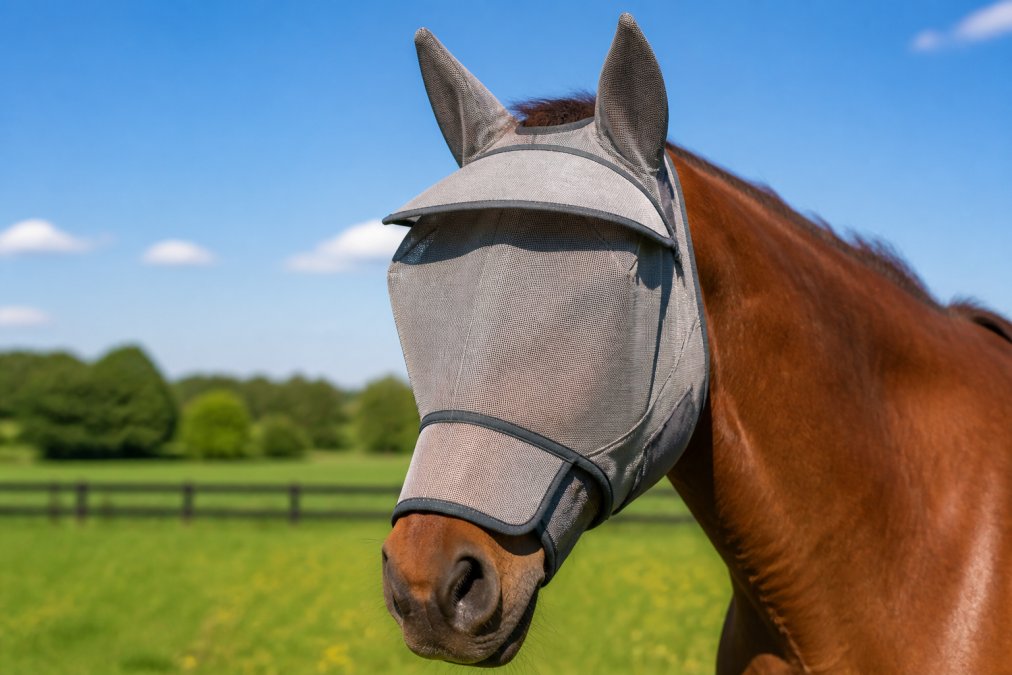
Coverage should match the threat. A horse with pink skin on the muzzle needs extended nose protection, while one prone to gnat bites around the ears benefits from ear protection built into the mask. Full-face coverage suits horses with broad sun exposure across the face.
A practical way to decide: map your horse's risk by body region. Pink or white markings on the muzzle and around the eyes are the highest-priority zones for UV-rated fabric. Ears matter most in wet, low-lying pastures where gnats and mosquitoes concentrate. If your horse has a history of uveitis or blue eyes, treat full-face coverage with a brow visor as the default rather than an upgrade.
Materials, Mesh Transparency, and Durability
UV protection in a fly mask comes from two mechanisms working together: the fabric itself and the mesh. Tightly woven or knit synthetic fabrics, typically nylon or polyester, block UV by physically scattering and absorbing radiation at the fiber level. Mesh does the same job while letting air and light through, which is why mesh transparency and UV blocking are not opposites. A finer mesh with a tighter weave blocks more UV and more insects, but it also reduces airflow and visibility, so the design has to balance the two.
When you compare masks, look at these construction details rather than marketing language:
- Mesh fineness and weave density. Finer mesh blocks smaller insects (no-see-ums, gnats) but can feel warmer. Coarser mesh breathes better but lets tiny insects through.
- UV-blocking fabric placement. The strongest UV fabric should sit over the eyes, brow, and any pink-skinned areas, not just the nose.
- Edge binding and seam construction. Flat, bound seams at the eye opening and nose edge reduce rub points. Overlocked or exposed seams are the first place a mask fails.
- Hardware. Buckles, hook-and-loop closures, and elastic straps determine whether the mask stays on. Metal hardware outlasts plastic in daily turnout, but it must be smooth to avoid pressure points.
- Lining at contact points. A soft lining at the cheekbones, brow, and behind the ears prevents the friction that causes hair loss and rubs.
How UV-Blocking Performance Is Measured, and Why It Fades
Most product pages quote a UV-blocking percentage without explaining where the number comes from. In practice, UV protection is measured by testing how much ultraviolet radiation passes through a fabric sample, usually expressed as ultraviolet protection factor (UPF). A UPF rating describes how much UV radiation the fabric blocks: higher UPF means more blocking. The percentage and the UPF rating are two ways of describing the same performance.
What almost no product page tells you is that UV-blocking performance degrades. Sun exposure, repeated washing, abrasion from pasture fencing, and stretching all break down fibers and open the weave over time. A mask that starts at a high UPF can lose a meaningful share of its blocking ability after a season of daily turnout, especially if it is machine-washed or dried in the sun. That is why the care instructions matter as much as the initial rating.
A reasonable rule: inspect the mesh over the eyes each month. If the weave looks stretched, thinned, or faded compared to a new mask, the UV performance has likely dropped with it. Rotating two masks and retiring the older one at the end of a season is cheaper than treating a sun-related eye problem.
University of Minnesota Extension horse care resources
Comparing UV Fly Mask Features and Value
Feature priorities shift depending on your horse's condition. Here is how to weigh them.
Priority |
Best For |
What to Check |
|---|---|---|
Maximum UV blocking |
Horses with uveitis or blue eyes |
UV-blocking percentage, visor coverage |
Extended nose protection |
Pink-skinned muzzles |
Nose length, UV-rated fabric |
Ear protection |
High-insect environments |
Built-in ear mesh, secure seams |
Breathability |
Horses with sensitive skin |
Moisture-wicking lining, airflow design |
Durability |
Daily turnout use |
Hardware strength, reinforced stitching |
TUFFTEQ builds its masks around a 95% UV eye protection rating, a built-in visor for shade and glare reduction, and high-grade nylon and mesh construction. For horses with eye trauma or uveitis, that combination targets the two triggers owners can control. Pricing depends on size and configuration, so check the TUFFTEQ website for current options.
Care, Cleaning, and Long-Term Use
Wash masks by hand in mild soap and warm water, then air dry away from direct sun. Inspect straps, seams, and hardware weekly for wear, since a failing strap is how masks get lost in the pasture. Rotate between two masks if your horse wears one daily.
Key TakeawayA clean, well-fitted mask protects better than an expensive one that rubs or slips. Maintenance is not optional if you want the UV rating to hold up over time.
Frequently Asked Questions
Do all fly masks provide UV protection?
No. Many standard fly masks block insects but offer little to no UV defense. Look for masks that state a specific UV-blocking percentage, such as 95%, and use high-grade nylon or micromesh. A UV-rated mask will specify protection levels, while a basic fly mask may only shield against biting insects. If your horse has uveitis or light-colored eyes, always choose a mask with verified UV protection.
How much UV protection does a horse need for their eyes?
Horses with healthy eyes benefit from at least 60-80% UV reduction, but those with uveitis, corneal ulcers, or photosensitivity need 90% or higher. A fly mask with UV protection rated at 95% blocks most harmful rays, reducing the risk of sunburn and glare-induced irritation. Always check the manufacturer's stated UV-blocking percentage and look for a built-in visor for extra shade.
Can a fly mask help prevent equine uveitis?
A fly mask with UV protection can reduce UV exposure, a known trigger for uveitis flare-ups in horses. While it won't cure the condition, consistent use during turnout helps manage symptoms and lowers the frequency of painful episodes. Pair the mask with veterinary care and pasture management. For horses with equine uveitis eye protection, choose a mask with full-face coverage and a secure, rub-free lining.
How do I know if my horse's fly mask fits correctly?
A well-fitted mask stays in place without collapsing inward, leaves no gaps around the eyes, and allows full visibility. You should be able to fit two fingers under the edges without the mask sliding. Check for rub marks on the face after a few hours. If the mask shifts or your horse rubs it constantly, try a different size or style. Measuring from the poll to the end of the nose helps you pick the right size.
Recent Post