

How to Measure Horse Head Size: A Step-by-Step Guide
Table of Contents
- Why Accurate Head Measurements Matter for Fly Mask Fit
- Tools You Need Before You Start Measuring
- Step-by-Step: How to Measure Horse Head Size
- How to Read a Horse Fly Mask Sizing Chart
- Preventing Fly Mask Rubbing and Fit Issues
- Breed-Specific Sizing: Pony, Cob, Full, Warmblood, and Draft
- Common Measuring Mistakes to Avoid
- Frequently Asked Questions
Last Updated: September 14, 2026
Why Accurate Head Measurements Matter for Fly Mask Fit
A fly mask that fits poorly does more harm than no mask: it rubs the cheekbones raw, collapses against the eye, and lets insects crawl underneath the gaps. Getting it right starts with learning how to measure horse head size properly, four specific points, not a guess from a photo.
This guide from TUFFTEQ covers every measurement you need for a fly mask, halter, or bridle, plus the sizing charts that turn those numbers into the right fit.
The stakes are higher for horses with light-colored faces, blue eyes, or a history of uveitis. A mask that shifts sideways exposes the eye to UV and debris. A mask that sits too tight creates pressure points behind the ears.
Getting it right takes about ten minutes. Below: how to do it, which tools to use, and the mistakes that send most people back to the sizing chart.
Tools You Need Before You Start Measuring
You need three things: a flexible measuring tape, a helper, and a calm horse tied in a safe, level space. A cloth tailor's tape works best because it follows the curves of the face; a rigid tape gives inconsistent numbers.
Gather these before you bring the horse out:
- Flexible cloth measuring tape, 60 inches or longer
- A second person to hold the horse and read numbers
- A halter that already fits reasonably well
- A notebook or printed worksheet to record each figure
- A treat or two to keep the horse relaxed
No cloth tape? Soft rope works: mark it at each point, then lay it flat against a metal tape measure. The numbers are just as accurate as long as the rope doesn't stretch.
Pro Tip
Measure in the morning before turnout, when the horse is dry and not puffy from heat or exercise. A sweaty or swollen face can add half an inch or more to your numbers, which throws off the final fit (pubmed.ncbi.nlm.nih.gov).
Step-by-Step: How to Measure Horse Head Size
Measuring a horse's head comes down to four core figures: the crown piece, the noseband, the cheek piece, and the throat latch. Each corresponds to a specific strap and anatomical landmark, miss the landmark by an inch and the whole fit shifts.
Have your helper hold the horse square and still. Stand to the side, not directly in front, so you can see where the tape lands.
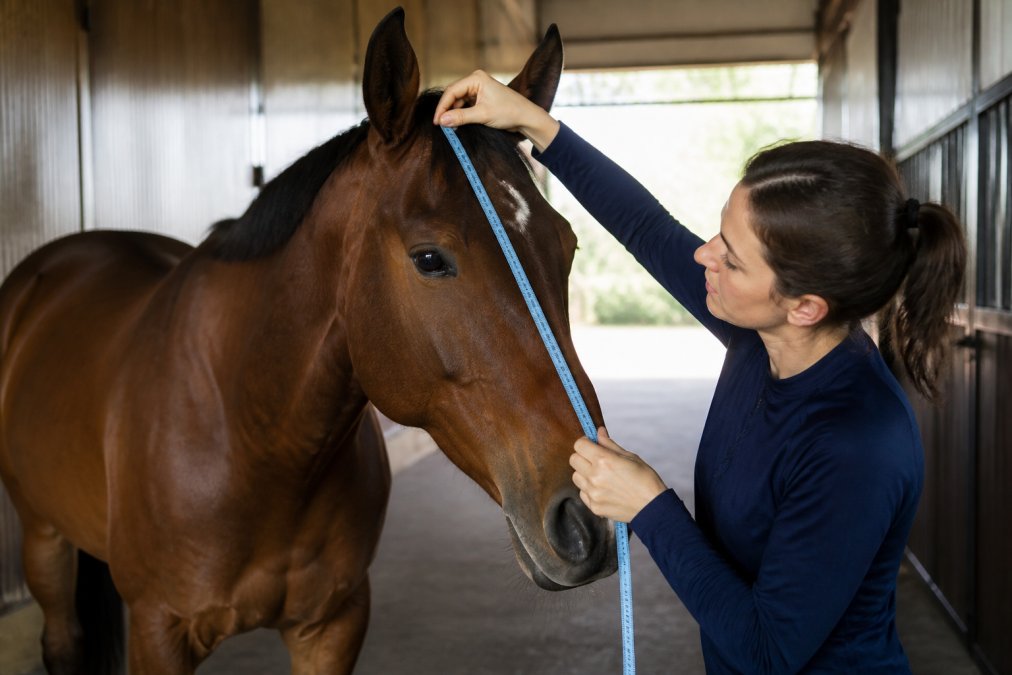
Here is the sequence to follow for every measurement:
- Locate the poll, the bony bump between the ears at the top of the head
- Find the cheekbone and the corner of the mouth as reference points
- Wrap the tape snug, not tight, and read the number at eye level
- Record each figure immediately before moving to the next
- Repeat any measurement that seems off by more than half an inch
Measuring for a Fly Mask
A fly mask sizing measurement uses the same landmarks as a halter, plus the distance from the poll to the bottom of the cheekbone. That tells you how far down the mask should hang and whether the eye darts will sit over the eye rather than above or below it.
Start at the poll and run the tape down the side of the face to the point of the cheekbone, just below the eye. Then measure the circumference around the noseband area, about two fingers below the cheekbone, and finally from the poll, under the throat latch, and back up to the poll on the other side.
Write all three numbers down, and note a broad forehead or narrow muzzle too, it matters when comparing against a sizing chart and when choosing between standard and wide cuts.
How to Measure for a Horse Halter
Halter measurement follows the same four points, but the crown piece and cheek piece carry more weight. The crown piece runs from the poll, behind the ears, across to the other side: measure a straight line from ear base to ear base, then add an inch for buckle adjustment.
The cheek piece runs from the crown, down past the cheekbone, to the bit attachment point at the corner of the mouth; measure it on the side of the face, following the jawline. The noseband wraps around the muzzle roughly two fingers below the cheekbone and should sit about an inch above the bit (pubmed.ncbi.nlm.nih.gov).
A common mistake is measuring the noseband too low, near the nostrils. That skews the number high and produces a halter that slips forward. Keep the tape on the bony part of the muzzle, not the soft tissue.
How to Read a Horse Fly Mask Sizing Chart
A fly mask sizing chart converts your measurements into a size label: pony, cob, full, warmblood, or draft. Rows list the sizes; columns list the ranges for crown, noseband, and cheek piece. Find the row where all three of your horse's numbers fall within range, that's your starting size.
Most charts overlap by an inch or so between adjacent sizes, intentionally, to account for head shape variation a single number can't capture. When your horse lands in the overlap, the decision depends on which measurement is closest to the edge:
- If the crown piece is at the top of a range, size up. A crown that's too short pulls the mask forward and drags the eye darts off the eye.
- If the noseband is at the top of a range, size up. A tight noseband is the number one cause of rub marks on the muzzle (pubmed.ncbi.nlm.nih.gov).
- If the cheek piece is at the bottom of a range, size down. A cheek piece that's too long drops the mask below the cheekbone and leaves the eye exposed.
- If two of three measurements point one way and the third points the other, follow the majority and use the adjustable straps to correct the outlier.
| Size | Crown Piece | Noseband | Cheek Piece | Typical Build |
|---|---|---|---|---|
| Pony | 30-33 in | 20-22 in | 6-7 in | Small head, fine bone |
| Cob | 33-36 in | 22-24 in | 7-8 in | Medium head, average bone |
| Full | 36-39 in | 24-26 in | 8-9 in | Standard riding horse |
| Warmblood | 39-42 in | 26-28 in | 9-10 in | Larger head, heavier bone |
| Draft | 42-46 in | 28-32 in | 10-12 in | Broad forehead, thick jaw |
When the Chart Doesn't Have Your Number
Some charts list only crown and noseband. If so, use the crown as your primary anchor and the noseband as a secondary check. The cheek piece is the most forgiving measurement because most fly masks have an adjustable cheek strap; the crown and noseband determine whether the mask stays on and whether it rubs.
If your horse's crown measurement falls above the largest size on the chart, you need a plus-size or custom option. Don't order the largest standard size and hope the straps compensate, a crown two inches short pulls the mask forward no matter how loose the buckles are.
Brand-to-Brand Label Drift
A "full" from one maker isn't always a "full" from another, label drift of one to two inches in the crown piece is common. The rule: ignore the label and match the numbers. Keep your horse's three measurements written down and compare them against the specific chart for the product you're buying, every time. If a product page doesn't publish a chart, look elsewhere or contact the seller first.
Watch Out
Never assume a size based on the horse's height or breed alone. Two 16-hand geldings can carry heads that differ by two full sizes. Measure every horse individually, and re-measure if the horse is young and still growing.
Reading a Chart for a Horse You Can't Measure
Buying for a horse you can't measure, a rescue, a lease, one at a trainer's barn? Estimate from a well-fitting halter. Ask the handler to measure the halter's crown piece and noseband laid flat, buckle to buckle. Those numbers run roughly an inch smaller than the horse's actual head measurements, because the halter sits over the hair and the mask sits against it. Add an inch to each figure as your starting point, then confirm the seller's return policy before ordering.
Preventing Fly Mask Rubbing and Fit Issues
Preventing fly mask rubbing comes down to three factors: correct size, correct strap tension, and daily inspection. A mask that rubs almost always has a strap too tight, a noseband too low, or a size a half-step off.
Check the fit after the first hour of wear. Look for:
- Red or rubbed hair behind the ears
- Gaps at the cheek where insects can enter
- The mask sliding sideways when the horse shakes its head
- The eye darts sitting over the eye, not above or below it
- Moisture trapped under the fabric on warm days
If the mask collapses inward against the eye, the crown piece is too long or the cheek piece is too short. If it slides forward, the noseband is too loose. If it leaves rub marks behind the ears, the crown is too tight.
Horses with sensitive skin benefit from breathable mesh and smooth seams. TUFFTEQ builds its fly masks with high-grade nylon and mesh, and the built-in visor keeps fabric off the eye while reducing glare for horses with uveitis or light sensitivity.
Breed-Specific Sizing: Pony, Cob, Full, Warmblood, and Draft
Breed and type influence head shape as much as size. A draft cross may take a full-size crown but a draft-size noseband; a fine-boned Arabian may need a cob noseband with a full cheek piece. Standard sizing assumes an average head, and few horses are truly average.
Here is how the common categories tend to break down:
Pony (crown 30-33 in, noseband 20-22 in, cheek 6-7 in). Welsh, Shetland, and most pony breeds. Short crown, narrow muzzle, often a wider forehead relative to the jaw. Many ponies need a cob cheek piece because their jaw is longer than their muzzle is wide.
Cob (crown 33-36 in, noseband 22-24 in, cheek 7-8 in). Cob-type horses, many Haflingers, and compact Quarter Horses. Compact head with a wider jaw than a pony. Fits most cob charts cleanly, and the cob category is the most consistent across brands.
Full (crown 36-39 in, noseband 24-26 in, cheek 8-9 in). The baseline for most riding horses, Thoroughbreds, Quarter Horses, most Warmbloods under 16.2 hands, and the majority of grade horses. Full on all three points is the easy zone; most off-the-shelf masks are built to this shape.
Warmblood (crown 39-42 in, noseband 26-28 in, cheek 9-10 in). Longer crown, heavier bone, often a broader forehead than a Thoroughbred of the same height. Dutch Warmbloods, Hanoverians, and Holsteiners commonly land here. Benefits from a wide-cut mask because the forehead width pushes a standard mask's eye darts outward.
Draft (crown 42-46 in, noseband 28-32 in, cheek 10-12 in). Clydesdales, Percherons, Belgians, and Shires. Broad forehead, thick jaw, and a noseband that can run two to four inches wider than a Warmblood's. Often needs a plus-size or custom option. The draft noseband is the measurement that most often exceeds standard charts.
The Crossbred Problem
Crossbreds are where standard sizing breaks down, and they're the most common horse in the barn. A Thoroughbred-draft cross might measure full on the crown, warmblood on the noseband, and draft on the cheek; a Warmblood-Arabian cross often measures cob on the noseband and full on the crown. No label fits them cleanly.
The practical approach: measure all four points, write them down, and match each to the chart independently rather than hunting for one size that fits all three. Choose the size matching your largest measurement, then use the adjustable straps to bring the smaller points into range. Buckles can be tightened to fit smaller points, but a mask can't be stretched to cover a larger one.
When to Go Custom
Custom sizing is worth the cost when your horse falls outside the largest standard size on two or more measurements, has rubbed in every off-the-shelf mask you've tried, or has a medical need, uveitis, a healing eye injury, or a light-colored face with a history of squamous cell carcinoma, where fit failure has real consequences.
Key Takeaway
The single most reliable rule for sizing: match your horse's largest measurement to the chart, then use the adjustable straps to bring the other points into range. Sizing down to fit one measurement almost always produces a mask that rubs or collapses.
Common Measuring Mistakes to Avoid
The same errors show up again and again, and each produces a mask that doesn't fit. Watch for these before writing down your final numbers.
Measuring over a halter. The halter adds thickness and inflates every figure by half an inch or more. Remove it first.
Pulling the tape tight. A flexible tape should sit snug against the skin, not compress it. If you can slide a finger under the tape, the tension is right.
Measuring a moving horse. A horse that's shifting, head-tossing, or eating throws off every number. Tie it square and wait for it to settle.
Skipping the cheek piece. Many owners measure the crown and noseband and stop there. The cheek piece determines where the eye darts land, and getting it wrong is the most common cause of a mask that sits too high or too low.
Using a rigid tape. A metal tape measure won't follow the curve of the jaw or the poll. Use cloth, or use rope and measure the rope afterward.
Re-measuring from memory. Write every number down as you go. Trying to remember four figures an hour later leads to errors.
For a worksheet to keep on file, print a table with columns for the date, crown, noseband, cheek piece, and throat latch. Re-measure twice a year, and any time the horse's condition changes.
Getting the fit right takes ten minutes and saves months of frustration. If your horse has uveitis, a light-colored face, or a history of rubs from other masks, the margin for error is even smaller. TUFFTEQ builds fly masks with a built-in visor for shade and glare reduction, 95% UV eye protection, and durable nylon and mesh construction designed for horses with sensitive skin or eye trauma. Measure carefully, match your numbers to the chart, and shop TUFFTEQ for a mask that stays in place and protects the way it should.
Frequently Asked Questions
What is the average size of a horse's head?
A typical adult horse's head measures roughly 22 to 26 inches from poll to muzzle, depending on breed. Ponies fall closer to 18 to 21 inches, while draft horses can exceed 28 inches. These are general ranges, so always measure your individual horse rather than relying on averages. A horse's head size directly determines which fly mask size fits correctly.
How do I determine the correct head size for a fly mask?
Use a flexible measuring tape to record three key measurements: poll to muzzle length, noseband circumference, and cheek piece length. Compare those numbers against the manufacturer's sizing chart. If your horse falls between two sizes, choose the larger size to prevent pressure points. A fly mask that sits too tight can cause rubbing and discomfort, especially around the eyes and ears.
Where should a fly mask sit on a horse's face?
A properly fitted fly mask sits with the top edge just below the ears and the bottom edge covering the nose without blocking nostrils. The eye darts should align with your horse's eyes, and there should be enough room to slide one finger under the noseband. If the mask slides down or twists during turnout, it is too loose. If it leaves deep indentations, it is too tight.
What are the signs that a horse's headgear is too tight?
Signs include visible indentations in the hair, head shaking, rubbing against fences, and hair loss along the noseband or cheek areas. Your horse may also become head-shy when you approach with the mask. Check for these signs daily during the first week of use. Adjusting the buckle or sizing up can resolve most tightness issues before they cause skin damage.
Recent Post